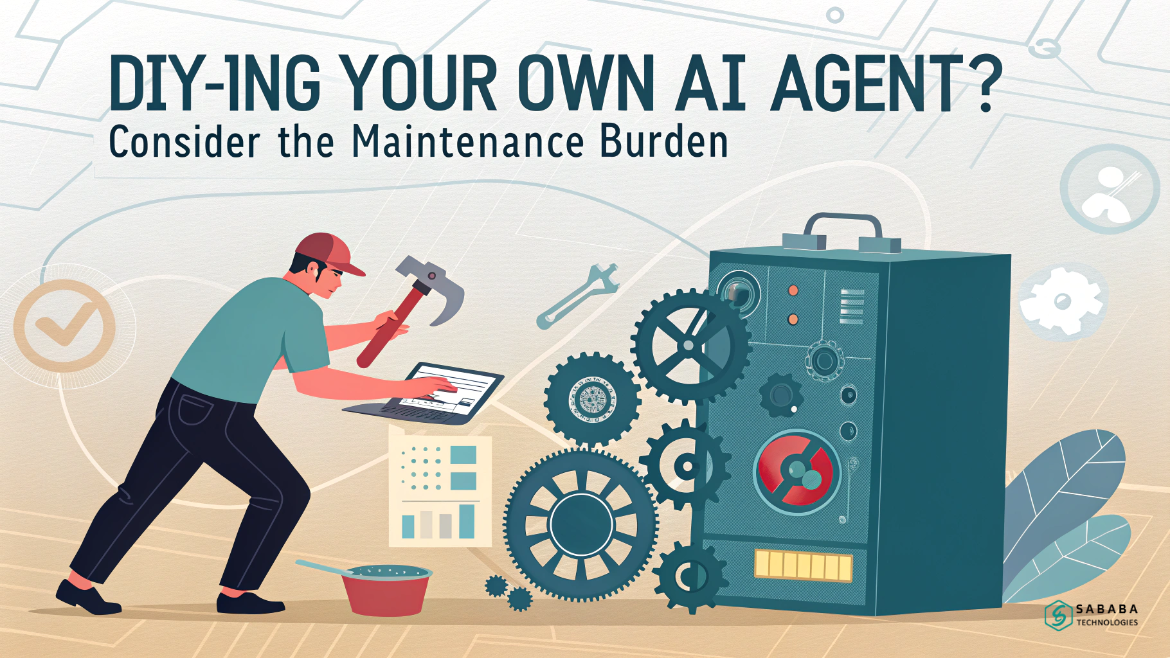
DIY AI Agent and AI Agent Maintenance may look easy, but hidden upkeep, fixes, and scaling issues can quickly turn into a major burden.
Launching an AI Agent feels exciting. However, anyone who has operated one in the real world knows that releasing it is not the finish line—it is the start of a complex journey. Maintaining a production-grade AI Agent introduces demanding engineering, continuous monitoring, model upkeep, and infrastructure challenges. Many teams discover too late that DIY solutions often turn into technical debt factories.
In this blog, we explore what makes DIY maintenance difficult, why performance degrades over time, and how platforms like Agentforce reduce operational overhead for long-term success. The goal is not just to build an AI Agent, but to ensure it stays accurate, trusted, and reliable.
The Reality of Maintaining a Production AI Agent
Most organizations assume that after deployment, their AI Agent remains stable. However, the digital world constantly evolves. APIs change, models update, and data ages. As a result, a DIY setup quickly turns into a fragile ecosystem requiring constant attention.
Even small infrastructure modifications can ripple through the system and damage performance without warning. This is where enterprise-ready platforms like Agentforce help engineers maintain stability instead of constantly fighting technical fires.
Model and Embedding Drift – The Silent Breakdowns
Why Models Age Faster Than You Think
Switching from one LLM model to another is not a simple configuration tweak. A single shift in tokenizer logic can break prompt structures. For instance, a prompt that once fit inside your 4k token window may suddenly overflow in a new model version, causing the AI Agent to behave inconsistently.
This leads to:
- Output formatting issues
- Increased hallucinations
- Context misalignment
- More brittle responses
When handled manually, such migrations require dozens of validation cycles. Agentforce simplifies this by automatically adapting prompts and mapping them to new model definitions, helping the AI Agent keep operating smoothly through transitions.
The Unseen Risks in API Contracts and Tooling
When the API Is Technically Correct But Semantically Wrong
APIs evolve. Sometimes, schemas remain intact, but meanings change. For example, a risk score API might shift from numerical rankings to strings like “LOW” or “HIGH.”
Your AI Agent continues receiving data, but its logic quietly breaks. These invisible failures are difficult to detect without deep semantic monitoring. Agentforce strengthens resilience by insulating integrations behind structured abstraction layers, ensuring fewer silent breakages and keeping the AI Agent on track.
Continuous Evaluation – The Core of Long-Term Reliability
In traditional DevOps, CI/CD validates code. In modern AI operations, CI/CE validates reasoning quality. A self-built approach means your team must manually:
- Create golden test sets
- Design synthetic failure scenarios
- Track drift in precision and recall
- Measure cost per model call
Without these safeguards, degradation creeps in. An AI Agent that once gave flawless results can decline into confusion, making customers lose confidence over time.
By contrast, Agentforce provides a built-in continuous evaluation system. It tests reasoning quality, evaluates responses against predefined standards, and helps keep every AI Agent running with consistency, clarity, and accuracy.
Why Day 2 Is More Complex Than Day 1
Launching an AI Agent Is Easy. Keeping It Working Is Not.
Building a prototype takes days. Maintaining a professional AI Agent takes years. Organizations that DIY soon find themselves juggling:
- Token management
- Infrastructure optimizations
- Schema versioning
- Data synchronization
- Latency benchmarking
- Failure cascades
- Unexpected planning logic defects
This is where platforms like Agentforce change the equation. Instead of building an entire AI maintenance ecosystem from scratch, businesses inherit a structured system designed for production stability.
Why Many Teams End Up Paying More for DIY
Even when the engineering team believes they are saving money initially, hidden costs quickly emerge:
- Engineering hours lost to debugging
- Production outages
- Unreliable user experience
- Increased infrastructure spend
- Constant rework on prompts, indexes, and workflows
Worse, as the AI Agent becomes core to business operations, downtime increases reputational risks. By centralizing orchestration, adaptation, monitoring, and integration, Agentforce helps protect the investment and safeguard performance without draining internal resources.
Agentforce – Reducing the Operational Load
A Unified Platform for the AI Agent Lifecycle
Instead of multiple disconnected systems, Agentforce provides:
- Model abstraction
- Tool orchestration
- Integration governance
- Continuous evaluation
- Multi-cloud compatibility
- Deep lifecycle observability
This helps teams:
- Scale faster
- Reduce maintenance friction
- Improve time-to-value
- Maintain accuracy under changing conditions
With Agentforce, the engineering team can focus on building real features instead of constantly fixing broken dependencies.
Building an AI Agent is only half the story. The real challenge begins after deployment when data, APIs, models, and infrastructure evolve. When teams attempt to maintain everything manually, performance slowly decays, operational costs rise, and the solution becomes fragile.
Using enterprise platforms like Agentforce transforms AI maintenance from chaotic firefighting into structured engineering. Instead of drowning in drift, schema changes, version issues, and reasoning failures, organizations gain a stable foundation that keeps every AI Agent reliable, transparent, and scalable.
FAQs
1. Why does an AI Agent degrade over time?
Because data, APIs, and models continuously change. Without monitoring, the logic powering the AI Agent becomes misaligned with current systems.
2. How does Agentforce help with AI Agent maintenance?
Agentforce abstracts model changes, monitors performance, and manages continuous evaluation, reducing manual effort and technical risk.
3. What is the biggest challenge of DIY AI Agent development?
Ongoing maintenance. Building is easy, but sustaining reliability requires continuous engineering and monitoring investment.
4. Why are API changes a risk for AI Agents?
Even when schemas remain valid, meanings can change, causing your AI Agent to misinterpret responses and generate incorrect decisions.
5. Do AI Agents need continuous evaluation?
Yes. Regular testing ensures reasoning quality remains consistent and prevents silent drift in performance over time.
Feeling more like puzzles than solutions? That’s when Sababa steps in.
At Sababa Technologies, we’re not just consultants, we’re your tech-savvy sidekicks. Whether you’re wrestling with CRM chaos, dreaming of seamless automations, or just need a friendly expert to point you in the right direction… we’ve got your back.
Let’s turn your moments into “Aha, that’s genius!”
Chat with our team or shoot us a note at support@sababatechnologies.com. No robots, no jargon, No sales pitches —just real humans, smart solutions and high-fives.
P.S. First coffee’s on us if you mention this blog post!