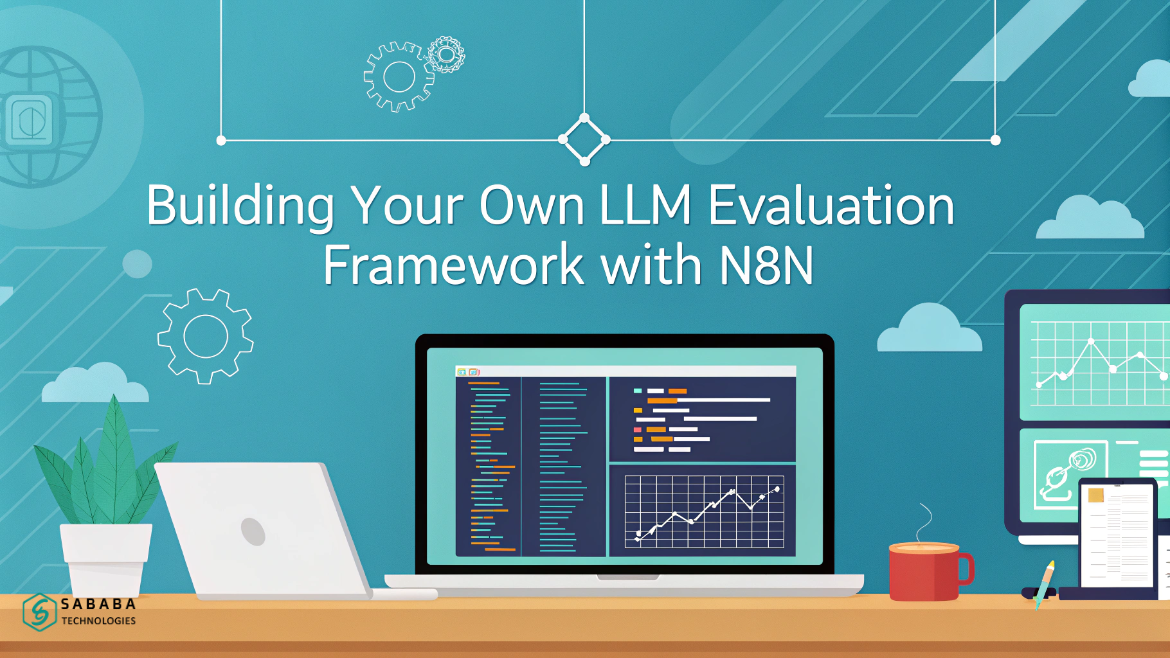
Build an LLM Evaluation Framework with n8n to strengthen AI Workflow Evaluation, test AI changes reliably, and improve output quality.
Building Your Own LLM Evaluation Framework with n8n
AI systems do not fail loudly. Instead, they drift. A prompt tweak here, a model swap there, and suddenly your outputs feel “off” without an obvious reason. This silent unpredictability is exactly why modern teams need an LLM Evaluation Framework baked into their automation stack.
Rather than guessing whether an update helped or hurt, structured AI Workflow Evaluation gives you clarity. In this guide, you will learn how to build a reliable, low-code evaluation framework using n8n—without slowing down experimentation or delivery.
Why AI Workflows Break Without Proper Evaluation
Traditional software behaves predictably. AI does not. Even when inputs stay the same, outputs can vary in tone, accuracy, or intent. Over time, this creates hidden risk.
An LLM Evaluation Framework helps teams replace assumptions with evidence. Instead of asking “Does this feel better?”, you can ask “Did this score better across our benchmarks?”
More importantly, AI Workflow Evaluation ensures that improvements remain improvements—even months later.
Why n8n Works So Well for AI Workflow Evaluation
n8n treats evaluation as a living process, not a one-time audit. That difference matters.
Visual, Low-Code Control
Because n8n runs on a visual canvas, teams can build evaluation logic without scripts or external tooling. You connect nodes, define metrics, and observe outcomes clearly.
Evaluation as a Separate Path
A clean AI Workflow Evaluation setup always stays separate from production logic. n8n supports this separation naturally, which prevents test data from leaking into live systems.
Metrics That Match Real Needs
Instead of forcing generic benchmarks, n8n lets you define what “good” actually means for your use case—whether that is speed, accuracy, tone, or tool usage.
Core Ideas Behind a Strong LLM Evaluation Framework
A durable LLM Evaluation Framework blends judgment with math. One without the other creates blind spots.
LLM-as-a-Judge for Human-Like Tasks
For creative or open-ended outputs, automated scoring fails. Here, one capable model evaluates another based on meaning, usefulness, or adherence to rules.
This approach gives AI Workflow Evaluation the nuance it needs without human review on every run.
Deterministic Metrics for Ground Truth
Alongside judgment, you still need hard numbers:
- Token usage for cost tracking
- Execution time for latency control
- Classification accuracy for structured tasks
Together, these metrics keep your LLM Evaluation Framework grounded.
Evaluating Advanced AI Workflows in n8n
Modern AI workflows rarely stop at text generation. They fetch data, call tools, and reason across systems.
Tool Usage and Decision Accuracy
n8n can verify whether an AI agent used the correct tool at the right moment. This is essential for automation that drives real business actions.
RAG and Source Faithfulness
When workflows rely on documents or databases, AI Workflow Evaluation ensures answers stay aligned with source material—not fabricated details.
Step-by-Step: Building an LLM Evaluation Framework with n8n
Step 1: Create Ground Truth Data
Store test cases and expected outputs in n8n Data Tables. Focus on real edge cases, not synthetic examples.
This dataset becomes the backbone of your LLM Evaluation Framework.
Step 2: Design the Evaluation Flow
Run test inputs through your AI logic while blocking production actions. n8n makes this separation simple and safe.
Step 3: Apply Evaluation Metrics
Configure categorization checks, AI-based scoring, and performance metrics directly in the workflow. This turns AI Workflow Evaluation into a repeatable habit.
Step 4: Compare and Iterate
Test different prompts or models under the same conditions. Because inputs remain fixed, results stay meaningful.
Best Practices for Reliable AI Workflow Evaluation
Even the best tools need discipline. Follow these principles to keep your LLM Evaluation Framework trustworthy:
- Never mix evaluation logic with production actions
- Keep a curated dataset of real-world failures
- Combine qualitative judgment with quantitative metrics
- Change one variable at a time
- Periodically audit LLM-as-a-Judge decisions
These habits protect your AI Workflow Evaluation from drifting over time.
What You Gain from a Strong Evaluation Framework
When evaluation becomes routine, teams move faster—not slower.
A well-built LLM Evaluation Framework helps you:
- Catch regressions before users notice
- Compare models objectively
- Optimize cost without sacrificing quality
- Ship AI updates with confidence
Most importantly, AI Workflow Evaluation restores trust in systems that would otherwise feel unpredictable.
Building your own LLM Evaluation Framework with n8n turns AI development into an engineering process instead of an experiment. By embedding AI Workflow Evaluation directly into your workflows, you gain visibility, consistency, and control.
Instead of hoping your AI behaves, you measure it. Instead of guessing, you know. And that shift makes all the difference when AI moves from demo to production.
FAQs
1. What is an LLM Evaluation Framework?
An LLM Evaluation Framework is a structured way to test and measure AI outputs using both automated metrics and contextual judgment.
2. Why is AI Workflow Evaluation necessary?
AI Workflow Evaluation helps teams detect silent failures, validate improvements, and maintain output quality over time.
3. Can n8n handle complex AI evaluations?
Yes. n8n supports tool usage checks, RAG validation, safety rules, and custom evaluation metrics.
4. How often should I run evaluations?
You should run evaluations whenever prompts, models, or logic change—and periodically as part of routine monitoring.
5. Is human review still required?
Yes. While automation scales evaluation, periodic human review keeps your criteria aligned with real expectations.
Feeling more like puzzles than solutions? That’s when Sababa steps in.
At Sababa Technologies, we’re not just consultants, we’re your tech-savvy sidekicks. Whether you’re wrestling with CRM chaos, dreaming of seamless automations, or just need a friendly expert to point you in the right direction… we’ve got your back.
Let’s turn your moments into “Aha, that’s genius!”
Chat with our team or shoot us a note at support@sababatechnologies.com. No robots, no jargon, No sales pitches —just real humans, smart solutions and high-fives.
P.S. First coffee’s on us if you mention this blog post!